What remains is the signature.
Every object has a fingerprint. We read it with a camera.
Two things off the same line look identical to a person. Their surfaces do not. Residue reads the microscopic texture each object is born with, names the object, and keeps naming it through years of wear. No tag, no serial, no scanner, and it never guesses.
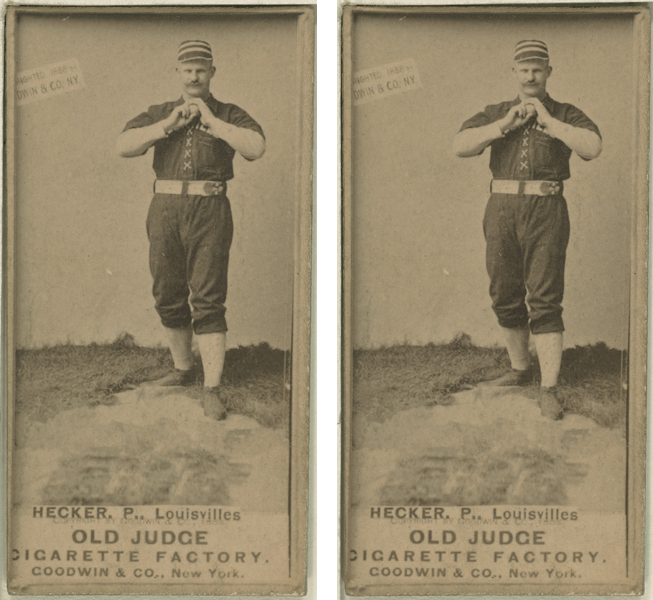
One card, scanned twice, years apart, by the Library of Congress. Filed as two items. Nobody told the software. It scored them 150 against each other while 1,222 pairs of different cards all scored under 11.5.
Two products
Paper and print need nothing but a phone. Worn metal and graphite need three lamps on a fixture. Same engine underneath.
Residue Photo
Enrol an object with the photo you already take at intake. Verify it later with one more. Built for vaults, returns, insurance, art custody and resale, where a trusted party sees the object first and it comes back later.
- Any phone or scanner. No lights, no rig, no tag on the object.
- Tells two copies from the same print run apart.
- Finds the original record from a broken or partial piece, and tracks condition change against a fixed original.
- Runs on your own laptop. No cloud, no per-scan fee.
Residue Station
A fixed camera and three LEDs read the true shape of a worn, curved, specular surface. Built for closed inventories where identical parts circulate for years: reactor fuel, aircraft parts, surgical tools, cast and printed parts, safeguards seals.
- Three lamps solve surface slope, so lighting and angle stop mattering.
- Subtracts what the whole batch shares. What is left is this part alone.
- Re-enrols every pass, so wear only has to be survived one cycle.
- Error budget derived from your part count and throughput.
Why labels, codes and tags are not enough
Vaults, reactors, hospitals, repair pools and insurers all run on things that look exactly alike. Each way of telling them apart has the same hole.
They get copied, cloned or worn off
A real cert number on a fake slab is a documented scam. Laser marks fade in sterilisation. An engraved code tells you what the code says, not whether the object under it is the one in the record.
They answer a different question
An authenticator says whether a bag or card is genuine. It cannot say whether the one that came back is the one that went out. Same-print-run copies are all genuine.
A score, billed per scan
The incumbent markets zero false positives, offers trials by discussion, and an independent 2023 study put installs from about $40,000. A score with no "not sure" turns every blurry photo into a verdict.
What the engine does today
Abilities in the shared engine today. Green means measured on real objects; the rest run on synthetic checks and are waiting for their first real capture.
Never guesses
Three outcomes: match, no match, retake. The retake rate is shown in every demo instead of hidden in the accuracy figure.
measuredSame-object check
Is this the exact physical object enrolled earlier? Tells copies of one print run apart.
measured on cardsBroken piece to record
A fragment, a corner, a worn-off label: locate it on the enrolled surface and return the original record, or refuse. 36 of 36 real card fragments traced.
measured on cardsMixed pile sorting
Several pieces, several origins: group each by its enrolled object, flag pieces that disagree, leave unknowns unassigned.
syntheticCondition history
Original identity stays fixed. Reviewed condition baselines are appended, so change is tracked without weakening identity. How it works.
syntheticMore than one sense
Backlight and registered CT volumes as independent channels. A supported channel can identify when the surface cannot. Disagreement is never averaged away.
syntheticReplay challenge
A one-use lighting sequence bound to the item and the moment. An old photo cannot answer it.
syntheticHands-free capture
Glasses companion that picks two usable frames from the stream under a one-use challenge. No photo button.
prototypeHow it works
Four steps, the same for a phone photo and a three-lamp station.
1 Photograph it
One photo from a phone or scanner, or three under three lamps for a worn metal part. Nothing is added to the object.
2 Remove what every copy shares
The printed design, the mould, the tool marks: the strongest signal in the frame and the worst identity signal. It aligns the photos, then it is subtracted.
3 Compare what nobody controlled
Paper fibre, ink dot placement, grain, wear. A real match is a sharp peak. A different copy is flat noise.
4 Name it, or ask again
A clear read gets a name. An unclear read gets another photo from another angle. No guess is ever written to a record.
Compared with the alternatives
Everyone in this field, in one table.
| Codes and tagsbarcode, RFID, laser engraving, quantum tags | Authentication servicesEntrupy, PSA, eBay authenticators | Photo-matching vendorsAlitheon, Veracity Protocol, NEC | X-ray CTUniversity of Illinois pebble work | Residue | |
|---|---|---|---|---|---|
| Works on objects already made, with no mark | No, must be applied first | Yes | Yes | Yes | Yes |
| Tells two copies from one print run apart | Only if the tag itself is secure | No, both are genuine | Yes | Yes | Yes, measured: 0 false accepts in 1,222 real pairs |
| Says "not sure" instead of guessing | No | Human judgement | Reports a score | Reports a score | Yes, a retake is a first-class answer |
| Finds the record from a broken piece | No | No | Damage tolerance claimed | No | Yes, with mixed-origin refusalsynthetic checks; real fragments pending |
| Hardware | Printer or engraver plus reader | Phone | Phone or industrial camera | 200 kV CT scanner, shielding, licence | Phone, or a camera and three LEDs |
| Runs on your own machine | Varies | Cloud, paid per authentication | Vendor service, trials by discussion | Lab software | Yes. Two dependencies, no GPU, no per-scan fee |
| Benchmark you can rerun | No | Vendor accuracy claim | Vendor accuracy claim; one 2023 study of 120 items | Published, simulated | Yes. Public data, one command |
| Error budget from your inventory | No | No | No | Test-set accuracy | Derived from your part count and throughput |
Sources, October 2026: Alitheon's own FAQ markets greater than 99.9 percent accuracy and zero false positives, with trials by request; an independent 2023 CALCE study recorded 119 correct of 120 items and installs from about $40,000. Entrupy went device-free in May 2026 and sells per authentication; it answers "is it genuine", not "is it the same one". PSA has fingerprinted cards at intake since buying Genamint in 2021; that record is PSA's alone. Kairos Power began laser-engraving codes into new fuel pebbles in October 2026. The Illinois group identifies pebbles from the particles inside by X-ray CT, 100 percent on 100,000 simulated pebbles.
Six industries, six working demos
Anywhere identical things circulate, wear, and have to be accounted for.
Collectible card vaults
In fakes intercepted by one grader in 2025. The cert proves the slab, not the card. Enrol the card itself at first custody and check it on the way out.
Returns and resale
Of retailers now see counterfeit decoys coming back in the box. Did the seller get back the bag that went out? One intake photo answers it. Leather in test.
Insured art and objects
A work returns from loan, consignment or recovery. Is it the one photographed at underwriting? A same-object check for the specialist, with a review record.
Nuclear fuel pebbles
Identical graphite spheres cycling through a reactor for years. Names the ball, counts its passes and spots a cracked shell from one glimpse. Nothing engraved, nothing cut, no CT scanner.
Used aircraft parts
Lost to one forged-certificate scheme, sentenced in 2026. Nine in ten stolen parts carry no serial. A pool of identical bearings, each named on return.
Surgical instruments, cast and printed parts, seals
Marks wear off in sterilisation; printed parts carry no serial; safeguards seals need a stated detection probability. Same station, three more benches.
The numbers
One benchmark on real objects, one on a stated physics model. They are never mixed, and both rerun with one command.
Real cards: 1,222 impostor pairs, zero false acceptsLibrary of Congress scans, 762 cards, 283 titles. Two accidental re-scans found at 68 and 150; worst impostor 11.5.+
| Population | Real on both sides? | Pairs | Accepted at 25 |
|---|---|---|---|
| Two different copies of the same card, same print run | Yes | 822 | 0 |
| Two unrelated cards | Yes | 400 | 0 |
| One card the Library catalogued twice | Yes | 2 | 2 |
| Simulated phone re-photograph | Upper bound | 200 | 156 |
| Simulated bad re-photograph | Upper bound | 200 | 55, the rest refused |
Threshold 25 is twice the worst impostor ever observed. Zero false accepts in 1,222 bounds the rate at about 1 in 400 at 95 percent confidence; no one-in-a-million figure is claimed, because the tail is not that well determined yet and we say so. About one second per comparison on a laptop, no GPU. Play with the real cards.
Station benchmark: 28 methods, identical dataResidue 391. Best rival 358. Standard photo-matching toolkit under 0.5.+
Separation score per 5 mm tile, 40 objects per condition. One camera view composes about 78 tiles. The plant needs 1.1 per tile. Surfaces simulated to published roughness statistics with real sensor noise.
| Method | Clean | 30 µm wear | 90% shared | 50% dust | All at once |
|---|---|---|---|---|---|
| Residue | 391 | 168 | 367 | 372 | 17.0 |
| PCA subspace, same band weighting | 358 | 170 | 334 | 334 | 14.4 |
| Raw correlation, shared subtracted | 53 | 38 | 23 | 13 | 1.2 |
| SIFT keypoints | 0.41 | 0.38 | 0.29 | 0.25 | neg |
| ORB keypoints | 0.39 | 0.35 | 0.31 | 0.09 | neg |
Keypoint matching, which published surface-fingerprint methods rely on, is at chance on nominally identical moulded parts: ORB 8% rank-1, SIFT 13%. Subtracting the shared component is worth 90× on its own; band weighting adds 8×. How the benchmark was run, step by step.
Worst-case physics: six passes of wear, flattest features in the literatureEvery cell clears the requirement. The worst corner clears it by 3×, with camera noise in.+
κ is how deep a surface feature runs compared with how wide it is. Published crack shapes on nuclear graphite put it as low as 0.03. Photon shot noise, read noise, 10-bit quantisation and a random sub-pixel shift on every read. Composed separation per view; the plant needs 9.8.
| Material removed | κ 0.5 | κ 0.1 | κ 0.05 | κ 0.03 |
|---|---|---|---|---|
| 1 µm, about one pass | 316 | 303 | 262 | 236 |
| 6.7 µm, top of one pass | 278 | 206 | 152 | 104 |
| 13 µm | 256 | 152 | 101 | 79 |
| 40 µm, six passes at the worst rate | 194 | 91 | 49 | 33 |
| Requirement | 9.8 | 9.8 | 9.8 | 9.8 |
Single-light genuine correlation 0.20 against 0.69 with three lights, and negative under the pessimistic physics. This is why worn metal gets the station and paper gets a phone.
From the second read on, every case clears the requirement by 8× or more at every κ.
Mass balance on AVR and THTR dust inventories gives 0.83 to 6.7 µm per pass, two independent routes agreeing within a factor of seven.
Failure modes and how each is handledGlare, dust, chips, missed reads, heat, radiation. Each with a number.+
Read again from another view, never guessed. The record waits for a clean read.
Cell-level scoring with a guard ring; dead cells dropped, the rest scored at full strength.
Miss five reads, survive six cycles on a stale template.
Per-read gain fit keeps subtraction clean; blow-off before imaging.
Three azimuths solved for slope per pixel.
Shared component estimated from the batch and removed.
Re-enrol on every read; the template is never more than one cycle old.
Station after the existing cooling buffer; visible self-emission is 3 × 10⁻⁷ of the lamps.
A one-use lighting challenge bound to the item and the moment, and two separated frames that must agree.
What a 224,000-part inventory requiresWhat a 224,000-part inventory actually requires, and how the system reaches it.+
Everyone else sells an accuracy number. We derived the number the plant needs, showed no dataset on earth can demonstrate it directly, and built the system that reaches it anyway.
113 cm² of surface, about 430 imaged tiles, 78 visible in one view, each with thousands of degrees of freedom, against a 36-bit identity budget. The margin comes from geometry.
False-match and false-non-match rates, 95% confidence intervals, held-out conditions, in ISO/IEC 19795 terms. One command reruns each benchmark.
Try it yourself
Swap a look-alike into the vault and watch the surface say no. Then open the station, sand a pebble down a micron at a time, switch to one lamp and watch it fail, re-enrol and watch it recover.